Norway invests heavily in research. But are we getting enough innovation in return?
Why stronger links between universities, companies and capital matter for Norway’s research-based innovation.
3 min read · English
According to Forskningsparken’s 2026 Arendalsuka event brief, Norway spends approximately twice the EU average on publicly funded research per capita.1 Yet in the Global Innovation Index 2026, Norway ranked 21st out of 139 economies, compared with Sweden in 2nd place, Finland in 8th, and Denmark in 9th.2
The difference becomes even more interesting when we look at innovation inputs and outputs. Norway ranked 16th for innovation inputs, reflecting its resources and conditions for innovation, but only 30th for innovation outputs.3 Figure 1 places this gap in a Nordic perspective.
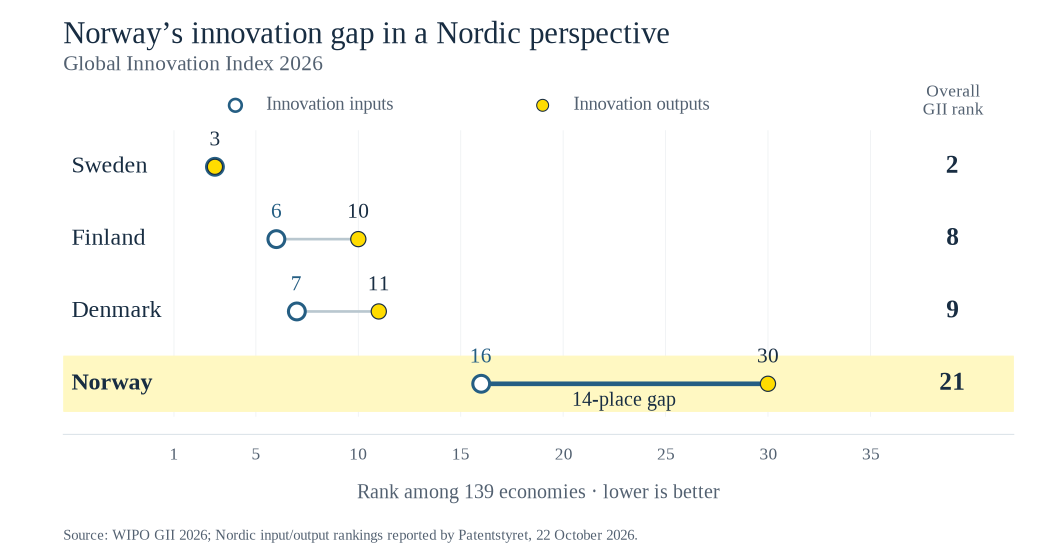
Figure 1. Innovation input and output rankings in the Global Innovation Index 2026. Lower ranks indicate a stronger position. These are ordinal rankings, not a measure of financial returns on research spending. Sources: WIPO and Patentstyret.
Another challenge is the connection between researchers and businesses. A recent Menon Economics study commissioned by Akademikerne found that Norway had approximately 55,000 employed people with PhDs in 2025, but only 38% worked in the private sector. Among PhD holders working in the state sector in 2015, just 5% had moved to the private sector eight years later.4
Financing is another barrier. According to Forskningsparken, Norwegian venture capital investment stands at roughly one-fifth of the EU level relative to economic output, with an estimated NOK 6.5 billion in additional annual investment needed to close the gap.5
These figures suggest that the challenge goes beyond research funding. It is also about incentives, researcher mobility, access to capital, and the difficult transition from scientific results to commercial applications.
At 00SMART, we see these challenges in building technology. Turning research in artificial intelligence, HVAC systems, building automation, and energy efficiency into practical solutions requires access to real building data, pilot facilities, technical expertise, and financing for development and validation.
A research idea can look promising on paper, but demonstrating that it works reliably in an actual building is a different challenge. This is where stronger collaboration between universities, research institutes, technology companies, and building owners becomes essential.
We believe Norway needs better mechanisms to support this transition, particularly for research-based startups that are too mature for early-stage research funding but still too small or risky for traditional innovation programmes and private investors.
Academic publications and fundamental research remain essential. However, technology transfer, industrial collaboration, and the development of practical solutions should also receive greater recognition and support.
Perhaps Norway does not need to choose between more research and more innovation. We need to become better at connecting the two.
What do you think is the biggest obstacle preventing more Norwegian research from becoming practical solutions?
Sources
- Forskningsparken (2026). Arendalsuka: Mye forskning – lite butikk, event brief on public research spending per capita.
- WIPO (2026). Global Innovation Index 2026 rankings and report announcement, 29 September 2026.
- Patentstyret (2026). Norge har ideene – men mister fart ut i markedene, 22 October 2026. Nordic input and output rankings.
- Menon Economics / Akademikerne (2026). Forskerkompetanse i norsk næringsliv; figures summarised by Akademikerne in Ny rapport: Det lønner seg å ansette folk med doktorgrad, 5 October 2026.
- Forskningsparken (2026). Mye forskning – lite butikk: Hvordan få mer næring ut av forskningspengene?, 26 August 2026.
Comments (0)
Be the first to join the discussion.