When a ventilation alarm should become a maintenance action
From sensor evidence to inspection, maintenance and a verified outcome.
4 min read · English
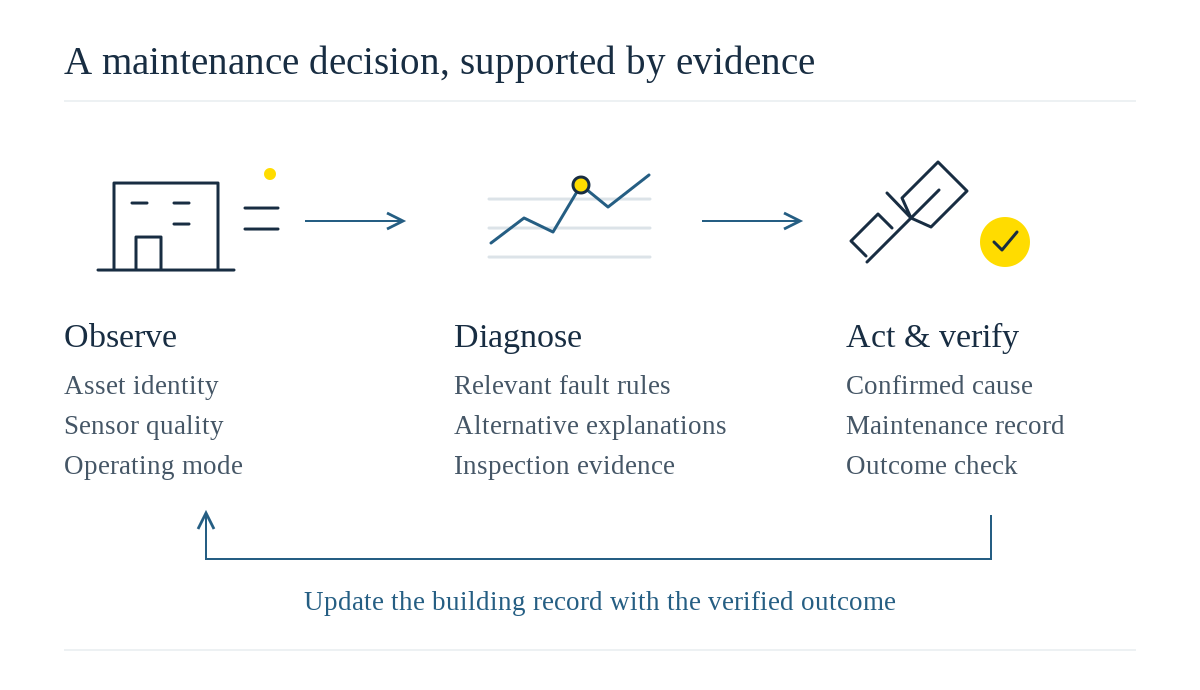
A useful ventilation alarm identifies the equipment, explains the concern and supports a decision. Producing more warnings is not the same as improving maintenance. A building digital twin should connect each alert to evidence that a facilities team can examine.
What our research established
Our 2022 study in Energy and Buildings combined APAR fault-detection rules, machine-learning condition prediction and maintenance planning. It connected measurements with BIM and maintenance information, using data collected between August 2019 and October 2021 from a Norwegian educational building.1
The study evaluated an integrated approach in that setting. The workflow discussed here is a practical interpretation for a new pilot; thresholds and performance still need to be established for the building concerned.
Start with usable evidence
APAR applies rules appropriate to the air-handling unit's operating mode. NIST's field-testing research describes identifying that mode from control signals before evaluating the relevant rules.2
The following checks make a diagnostic easier to interpret and act on.
| Check | Evidence to retain | Purpose |
|---|---|---|
| Equipment identity | Asset identifier, location and BIM or maintenance record | Find the correct unit |
| Point meaning | Sensor location, units; measured or commanded value | Compare the correct quantities |
| Time alignment | Time zone, sampling interval and clock changes | Establish the sequence of events |
| Availability | Missing intervals, frozen values and interpolation | Identify usable observations |
| Operating state | Fan status, schedules, setpoints and overrides | Apply the relevant diagnostic |
| Recent intervention | Inspections, repairs and control changes | Explain changes in behaviour |
A consistent asset identifier is especially useful: it connects an alert to the location, inspection task and service history. Geometric detail cannot compensate for inconsistent equipment records.
Turn the alert into an investigation
An unexpected value is a symptom, rather than a confirmed component failure. A short review can distinguish several explanations.
| Observation | Questions to investigate |
|---|---|
| A temperature barely changes | Is the value updating? Is the unit operating? Does an independent reading agree? |
| Expected and measured behaviour disagree | Are timestamps aligned? Is the operating mode correct? Has a setpoint changed? |
| A warning returns after repair | Was the cause removed? Was the sensor checked? Has the operating condition returned? |
The inspection result should remain linked to the original warning, including cases where no fault is confirmed. Otherwise, the record favours the cases that were easiest to resolve.
Evaluate the decision and its outcome
Detection, diagnosis and forecasting require different evidence. Identifying a current deviation does not demonstrate that a system predicts future failures. A pilot should explain how faults were confirmed, which periods were excluded and how often alerts led to no useful action.
Prediction tests should use later observations and exclude information that became available only after an intervention. This helps distinguish useful forecasting from a model that benefits from knowledge of the outcome.
Energy and cost results need a separate assessment. FEMP guidance describes documenting a baseline, choosing a measurement-and-verification approach and accounting for relevant changes.3
A pilot agreement should specify the energy boundary, comparison period and relevant operating conditions. Comfort and ventilation performance belong alongside consumption. Repairs, schedule changes and software updates should remain distinguishable in the intervention history.
The final record can be concise: asset, observation period, suspected cause, inspection result, action and verification. This traceable decision is a stronger basis for expanding a pilot than the number of alarms on a dashboard.
Sources and further reading
- Hosamo, H., Svennevig, P. R., Svidt, K., Han, D. and Nielsen, H. K. (2022). A Digital Twin predictive maintenance framework of air handling units based on automatic fault detection and diagnostics. Energy and Buildings, 261, 111988. Open-access record.
- Schein, J., Bushby, S. T., Milesi-Ferretti, N. S. and House, J. (2003). Results from Field Testing of Air Handling Unit and Variable Air Volume Box Fault Detection Tools. NISTIR 6994.
- US Department of Energy, FEMP. Measurement and Verification Activities Required in the Energy Savings Performance Contract Process.
Related: From Arendalsuka to measurable building performance.
Comments (0)
Be the first to join the discussion.